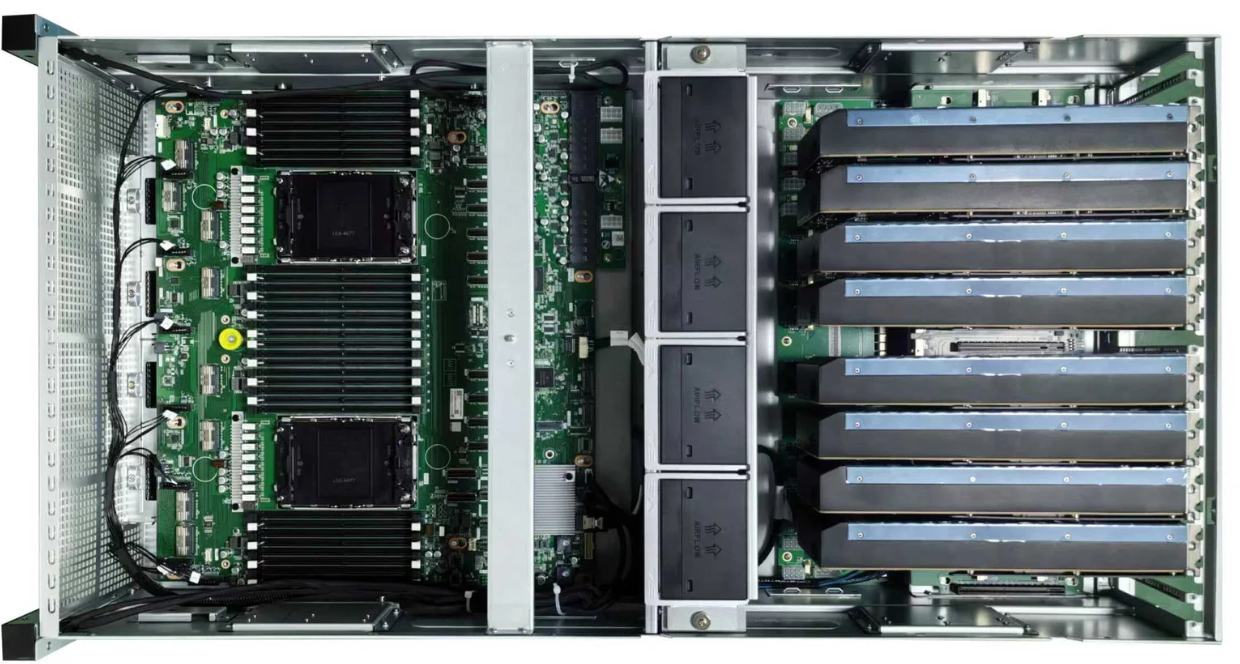
Enterprises and governments help ai server farm projects in 2026. They do this by buying better hardware and building strong infrastructure. The need for ai workloads is growing very fast. Organizations pick high-performance servers like those from sz-xtt. These servers have new models with multi-GPU support. Smart investments help upgrade technology. This also helps reach important goals.
Statistic/Insight | Description |
|---|---|
AI Budget Growth | In 2026, budgets for AI will go up by double digits. |
AI Adoption Rate | About 70 to 75 percent of organizations use AI in some business area. |
Global Investment Projection | Experts think global AI investment will be more than $2 trillion. |
Key Takeaways
Enterprises and governments are spending a lot on AI server farms. They do this to handle more AI work. High-performance servers use many GPUs, like NVIDIA A100. These servers help process data fast and do deep learning. New cooling methods, like liquid cooling and AI-powered systems, save energy. They also help lower costs in data centers. Using renewable energy and energy-efficient chips is important. These practices help the environment. Public and private sectors must work together. This teamwork builds strong digital infrastructure and helps AI grow.
AI Server Farm Technology
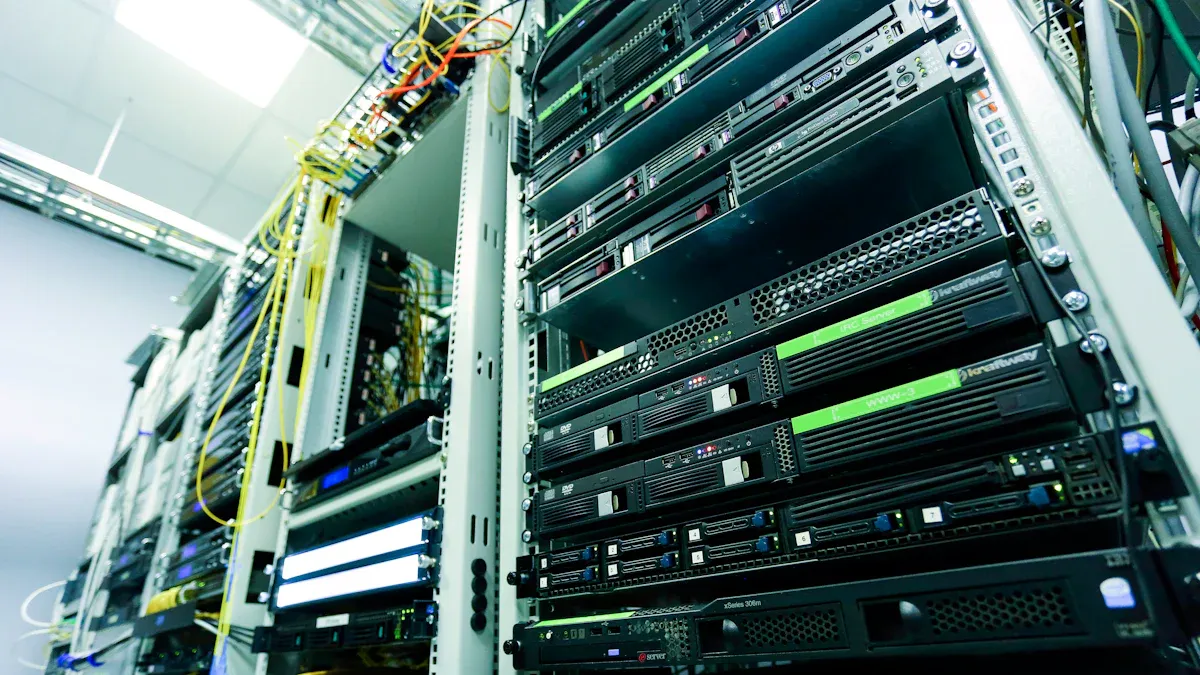
AI Hardware and GPU Solutions
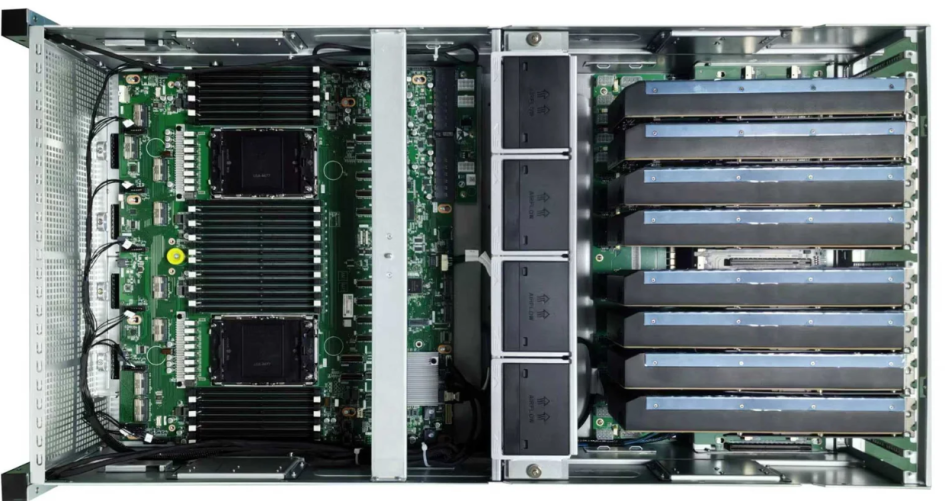
Enterprises and governments need strong hardware for ai workloads. The ai server farm uses servers like the 4U AI Server, H6237, and TG series. These servers do big jobs and work well. They use more than one GPU to make things faster. This helps with data analysis and deep learning.
Many groups pick servers with NVIDIA A100 GPUs. These GPUs have Tensor Cores and use different precision formats. They can reach up to 2TB/s memory bandwidth. This is good for big models like 70B-parameter language models. A100 servers work well with NVLink. NVLink connects many GPUs for more power.
Some teams use the NVIDIA DGX Spark. It is small and fits on a desk. It works like a big computer in a data center. Startups and small teams use it to test ai models. They do not need to build large infrastructure. DGX Spark helps with data analysis and making content.
New GPU solutions help ai server farms work better. The table below shows two popular GPU models:
GPU Model | Memory | Bandwidth | Large Model Handling | Inference Speed |
|---|---|---|---|---|
H100 | 80GB HBM3 | 3.35 TB/s | 70B+ parameters | 90.98 tokens/sec |
RTX 4090 | 24GB GDDR6X | 1 TB/s | 20B parameters | Half of H100’s speed |
GIGABYTE’s 4U AI Server, H6237, and TG series have good cooling and strong hardware. These features help servers work well and stay reliable. Enterprises and governments can add more servers as they need. This helps them grow and use more ai. It also helps digital infrastructure get bigger.
Power & Cooling Innovations
Power and cooling are very important in data centers. As ai workloads get bigger, power management must improve. Advanced cooling keeps things cool and saves money. Liquid cooling is better than air cooling. It moves heat 3,500 times faster. This helps save energy and lowers costs.
AI-powered cooling uses real-time data to make cooling better. It saves energy and keeps equipment safe. Zonal cooling cools only hot spots. This saves power and stops overcooling. Some data centers use cooling when renewable energy is high. This lowers their carbon footprint.
AI can lower energy use in data centers by up to 40%. It checks energy needs every five minutes with many sensors. The system gives tips to use less energy. Operators check and use these tips.
The table below shows new ideas in power and cooling:
Innovation Type | Benefits |
|---|---|
Liquid Cooling | Moves heat well, saves energy, lowers costs |
AI-Powered Cooling | Makes cooling better, saves energy, keeps things safe |
Zonal Cooling | Cools hot spots, saves power, stops overcooling |
Renewable Energy Usage | Uses renewable energy, lowers carbon footprint |
Liquid cooling helps save energy and makes chips work better. Some data centers get a PUE as low as 1.02. This means less carbon footprint and lower costs. Good cooling helps chips work well and last longer. Liquid cooling costs more at first but saves money later.
Sustainable Data Center Practices
Sustainability is very important for ai data centers. Operators use ways to help the environment and grow. They use energy-efficient AI chips like new GPUs and TPUs. These chips use less energy for each job. Algorithmic optimization helps save power without losing performance.
Many data centers use immersion cooling and renewable energy. Some use waste heat for other things. Smart scheduling matches ai tasks with times when renewable energy is high. This helps save money and helps the environment.
Environmental sustainability: Uses less power, makes fewer emissions, and less e-waste.
Economic efficiency: Energy-saving devices and smart workloads lower costs.
Regulatory compliance: Sustainable ways help meet laws and get green rewards.
These actions help digital infrastructure grow. They make sure enterprise and government investments in ai server farms give long-term value.
AI Data Center Investments
Public-Private Funding Models
Public and private groups work together to build data centers. This teamwork helps fix problems like power supply and grid limits. It also helps with changing rules. Moody’s says the need for more data centers keeps growing in 2026. AI, cloud computing, and digital services make this happen. Many countries try new ways to pay for these projects. The German government started the IPCEI-AI program. This program helps companies use AI in factories and other places. It shows how public and private groups can share costs and risks.
Governments want to control their data and computing. They build national AI systems and local data centers. These projects use money from both public and private sources. This helps keep data safe and builds strong digital infrastructure. The goal is to support more AI workloads and have enough power for the future.
National Infrastructure Initiatives
Many countries spend a lot on big projects for AI and data centers. These projects help grow capacity and make power systems better. The table below lists some important national initiatives:
Country | Initiative Description |
|---|---|
China | Invests in telecommunications, surveillance technologies, and AI startups through the Digital Silk Road. |
Starts a joint AI Cooperation Center with ASEAN and a three-year plan for AI projects. | |
United States | Focuses on education programs and local projects to support democratic ideas in AI. |
Works with Southeast Asian countries to match Western standards and technology. | |
Vietnam | Plays a new role in AI and semiconductor sectors, helped by U.S. tech investments in data centers and cloud services. |
Vietnam stands out with a $7 billion investment in AI data centers. This is more than many other countries spend. The chart below compares investment amounts in Vietnam, Singapore, Indonesia, and Malaysia.
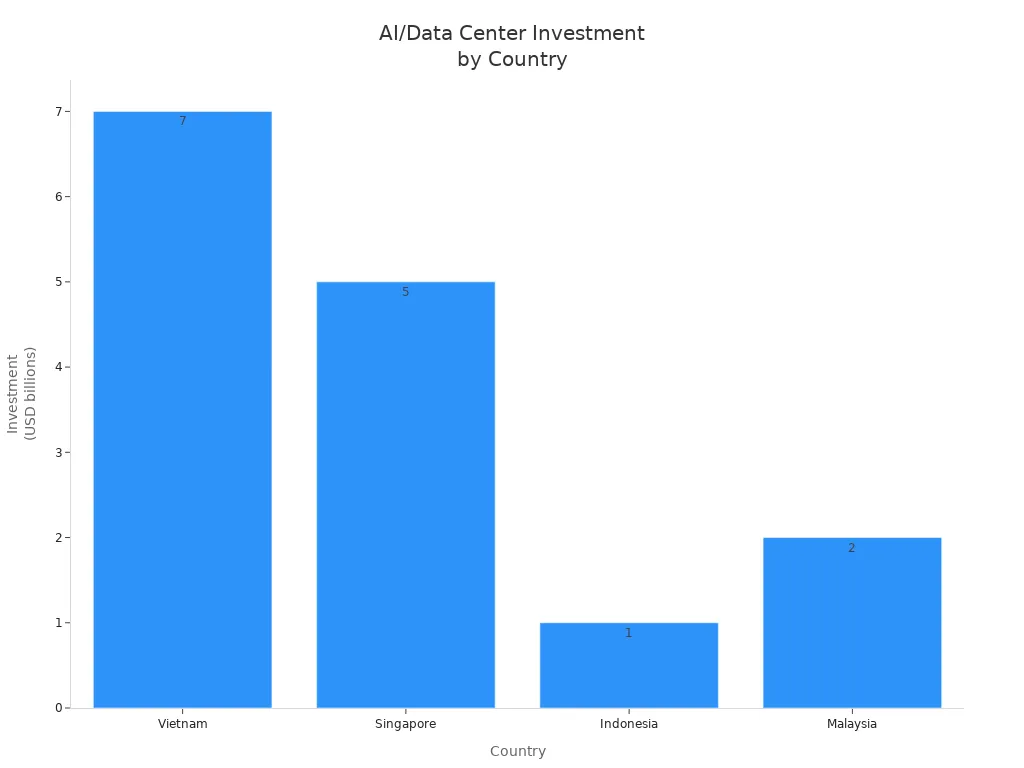
Vietnam’s National Digital Transformation Program makes AI very important.
The country is 5th in ASEAN for AI readiness and 59th in the world.
This shows Vietnam’s strong place in the AI sector.
Other countries also spend a lot. Singapore puts $5 billion into its Smart Nation plan. Indonesia and Malaysia focus on digital economy and AI analytics. These projects help grow data center capacity and support more AI workloads.
Enterprise Expansion Strategies
Enterprises help build new data centers. They spend lots of money to add power and capacity. The table below shows how some companies invest:
Company | Investment Amount | Purpose |
|---|---|---|
$80 Billion | Build advanced AI data centers | |
$75 Billion | Next-generation AI-optimized data centers | |
IBM | N/A | Hyperscale data centers for AI model training |
Oracle | N/A | Cloud services inside client premises |
Enterprises use different ways to expand. Some mix on-premise resources for sensitive tasks with cloud facilities for bigger AI jobs. Others use interconnection solutions to boost performance and flexibility. These steps help them handle more power and bigger AI projects.
The global market for data centers keeps getting bigger. Experts think spending on AI infrastructure could reach $2.5 trillion to $6.7 trillion by 2030. Big companies like Amazon AWS, Microsoft Azure, Google Cloud, Meta, and Oracle provide over 75% of global cloud infrastructure. US electric utilities plan to spend almost $208 billion on the power grid in 2025 and more than $1.1 trillion over five years. This spending helps meet the rising demand from data centers and AI.
By 2030, global data center capacity will double. AI workloads will use half of this capacity. The Americas will have 50% of global capacity and grow fastest. The Asia-Pacific region will go from 32 GW to 57 GW. Europe, the Middle East, and Africa will grow by 13 GW. These trends show why power, energy, and investment matter for the future of data centers.
Tip: Enterprises and governments that invest in power and digital infrastructure now will lead the AI server farm market later. Sustainability and smart planning help them stay ahead.
Data Centre Outlook: Regional Trends
Leading Countries and Approaches
Some countries are leading in building new data centers. The United Arab Emirates started a National AI Strategy. This plan helps the economy and makes government services better. Saudi Arabia made the Saudi Data and Artificial Intelligence Authority. They want to spend $20 billion on AI by 2030. Europe cares about saving energy and building in new ways. These places use smart power and energy-saving designs. Their data centers are growing fast and showing new ideas.
UAE wants to lower admin costs by half with AI.
Saudi Arabia calls data the “oil of the 21st century.”
Europe puts money into green data centers and better buildings.
sz-xtt Flagship Projects
New ideas in each region help data centers do well. sz-xtt is known for big AI data center projects. Their enterprise solutions use lots of GPUs and smart power systems. These projects help run big AI jobs and let companies grow fast. For example, Google’s AI Data Centre on Christmas Island uses green energy and smart cooling. AI racks can now use up to 1 megawatt each. This means they need liquid cooling and direct current power. sz-xtt works on saving power and being green. This helps companies and governments handle more work.
Note: Good cooling and power systems keep equipment safe and save money for companies.
Emerging Markets
Newer markets are spending a lot on AI server farms. The world AI market could be $144.6 billion by 2028. The AI data center market might grow from $236.44 billion in 2025 to $933.76 billion by 2030. Asia Pacific is growing fast because of digital changes and government help. China, Japan, India, and South Korea are building new data centers for more power. Brazil is also making bigger centers for lots of GPUs. These steps help companies and governments keep up with AI growth.
AI data centers may grow by 31.6% each year from 2025 to 2030.
Asia Pacific has the biggest share because of better buildings and power upgrades.
Security and Workforce in AI Data Centers
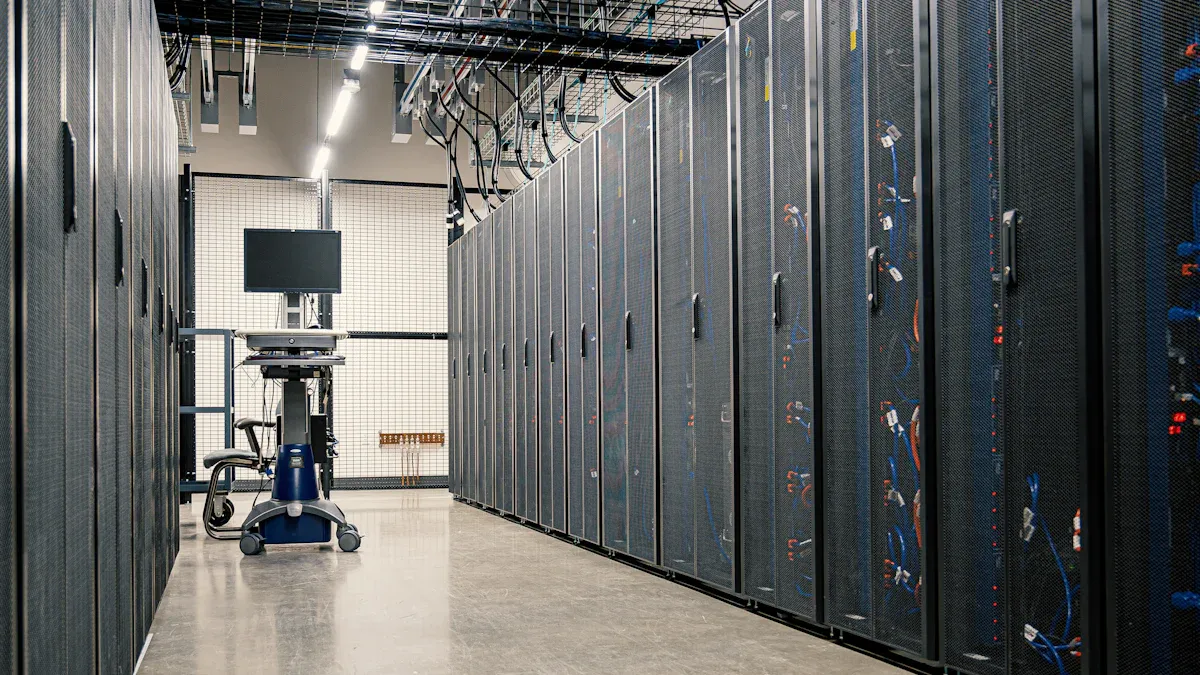
Data Protection & Compliance
Security rules for data centers change often. In 2026, new laws like the EU’s NIS2 Directive and Cyber Resilience Act need strong protection for digital products. The U.S. has the Cyber Incident Reporting for Critical Infrastructure Act. These laws make teams report cyber incidents fast. They must train workers, manage risks, and check supply chains. Companies watch vendors closely. Weak vendors can cause trouble. Many groups use vendor checks and safe data sharing rules. They watch for threats from partners and contractors all the time.
Data protection needs every vendor to be careful.
Inside security is not enough if partners are weak.
Managing vendor risks is very important now.
Safe data sharing and watching threats help keep data safe.
Operational Efficiency
Enterprise teams check how well data centers work. They use key performance indicators (KPIs) to track energy, cost, and sustainability. These numbers help them make things better and save money. The table below shows common KPIs for AI data centers:
KPI | Description | Measurement Criteria |
|---|---|---|
Energy Consumption per AI Workload | Tracks energy use for each AI job | Kilowatt-hours per training run |
Carbon Emissions per AI Application | Measures emissions for each AI task | CO₂ emissions per AI use case |
Model Efficiency, Not Model Size | Focuses on performance per compute unit | Accuracy per watt consumed |
Infrastructure Efficiency | Checks how well the physical setup works | Power Usage Effectiveness (PUE) |
Cost-to-Value Efficiency | Looks at cost compared to business value | Cost per inference |
Transparency and Reporting Coverage | Ensures full reporting for sustainability | Percentage of systems with energy reports |
Leaders use these KPIs to plan investments. They want data centers to use less energy and make fewer emissions. Good reports help them reach sustainability goals.
Talent Development
AI data centers need skilled workers. Teams look for people who can run AI jobs and keep systems working. Some important jobs are AI infrastructure operations engineers, digital twin technicians, and automation engineers. These workers design systems that need little help. Infrastructure strategists plan for future needs and make sure AI works well.
Problem-solving and thinking skills matter most.
Workers must learn new skills and adapt.
Technical knowledge is needed, but soft skills help teams do well.
Organizations spend money on training programs. They want teams to learn new technology and security skills. This helps data centers stay safe and work well.
Impact on Enterprise IT and National Infrastructure
Business Model Transformation
AI server farms change how companies use IT. Many businesses now add more servers when they need more power. This is called horizontal scaling. HPE Scale Up Servers help companies do this. Companies can handle AI workloads better and stop slowdowns. For example, a big e-commerce company got 40% faster during busy times by adding servers quickly. Serverless computing also changes how companies work. Cloud services manage the infrastructure for them. Teams can focus on their main jobs. This makes building new things faster and saves money. Companies do not have to manage every server anymore.
Integration with National Strategies
Governments think AI is important for their plans. They spend money on data center projects to reach national goals. These projects help countries go digital and grow their economies. Many countries start special programs to build new data centers. These centers help public services, research, and security. National plans often have rules for how data centers work. These rules make sure centers use less energy and stay safe. Governments also want more green technology. This helps protect the environment.
Societal & Economic Effects
AI server farms bring big changes to people and the economy. They make new jobs in technology and engineering. People learn new skills to work in data centers. Local businesses get bigger when new centers open. Communities get better internet and digital services. AI helps fix problems in health, education, and transport. Data centers give the power needed for these solutions. When more centers use renewable energy, they help lower pollution and protect the planet.
AI server farms use renewable energy and new cooling systems. They have modular designs to handle more work. Companies spend money on geothermal and nuclear power. Governments help by making energy cheaper and setting cloud rules. North America, Europe, and Asia-Pacific grow in different ways. These changes let businesses and people get better technology. Data centers will get smarter and greener as AI becomes common.
FAQ
What is an ai-focused data center network?
An ai-focused data center network links many servers together. It helps them do artificial intelligence tasks. This network moves data quickly and works well. Enterprises and governments use these networks for big ai jobs. They also use them to support digital infrastructure spending.
How do data centers manage energy and power for ai workloads?
Data centers use smart cooling, renewable energy, and advanced systems. These tools help control energy and power. They also lower costs and help with sustainability goals. Operators watch how much energy the data center uses. This keeps the data center working well and safely.
Why is sustainability important in ai infrastructure projects?
Sustainability means using less energy and helping the environment. Many data centers use green technology and new ideas for sustainability. These steps help data centers grow and follow government rules for clean infrastructure.
How do enterprises and governments increase data centre capacity?
Enterprises and governments make data centers bigger by building new parts and upgrading old ones. They add more servers and make digital infrastructure better. This helps with the ai and data center boom. It also meets the need for more artificial intelligence.
What are the main benefits of digital infrastructure investment?
Digital infrastructure investment gives better connections, more space, and faster progress. It helps enterprises and governments run ai jobs, improve data centers, and get ready for new technology.